Your Body Remembers Home Differently Than You Do
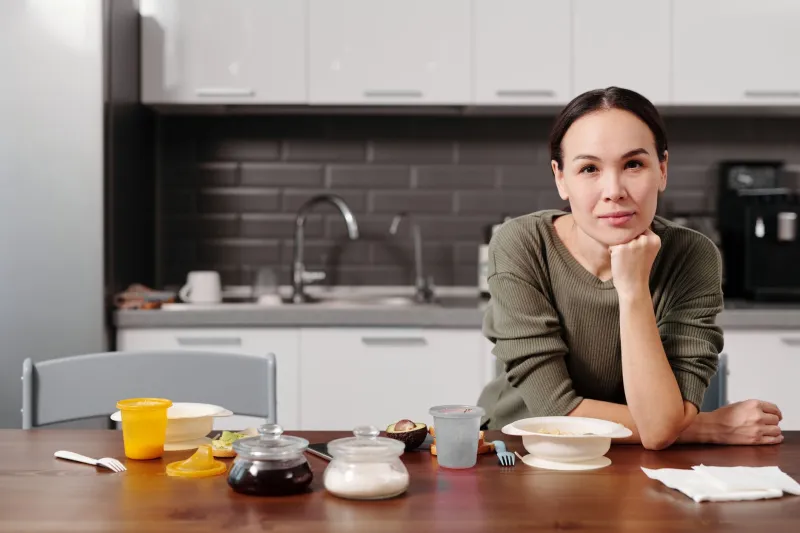
You're back in the States. You're sitting at your mom's kitchen table eating the exact meal you craved for the last two years abroad — maybe it's her pot roast, maybe it's a Thanksgiving plate in July because she wanted to celebrate you being home. And something is... off. Not wrong, exactly. Just not what you remembered. The flavors are flatter. The portion feels overwhelming. You smile anyway, because how do you explain to someone who loves you that their cooking tastes like a cover version of a song you used to know?
This is reverse culture shock — but not the version anyone warns you about. Not the political discomfort, not the social awkwardness, not the existential spiral of wondering where you belong. This is the version that lives in your body. In your taste buds, your skin, your nervous system. And it's one of the strangest, most disorienting parts of coming home that almost nobody talks about.
Why Food Tastes Different (And It's Not Your Imagination)
Let's start with the obvious one, because almost every returning expat has a version of this story. You spent two years eating fresh market produce in Southeast Asia, or hand-pulled pasta in Italy, or street tacos in Mexico City. You come home, bite into something you used to love, and it doesn't land the way it should.
There's real neuroscience behind this. Taste perception isn't fixed — it's shaped by context, repetition, and what your brain has been trained to expect. When you spend an extended period abroad, your palate literally recalibrates. Your baseline shifts. The sweetness of American processed food, which you once found normal, can suddenly register as aggressive. The saltiness of fast food hits differently. Even the texture of bread — because American bread is genuinely different in moisture and density from most European or Latin American equivalents — can feel wrong in your mouth.
Beyond the chemistry, there's memory. Taste is one of the most emotionally loaded senses we have. That pot roast isn't just food — it's a memory, a relationship, an expectation. When the reality doesn't match the memory you built up over years of distance and longing, the disconnect can feel weirdly personal. Like something got lost in translation between who you were when you left and who you are now.
Give it time. Your palate will find a new equilibrium. But in the meantime, be gentle with yourself when your favorite childhood meal doesn't hit right. It's not ingratitude. It's neurology.
The Weather Your Skin Forgot
This one sneaks up on people. You moved back to the Midwest from Portugal, or back to a rainy Pacific Northwest city after years in the dry heat of the Middle East, or back to Florida after living somewhere with actual seasons. And suddenly, the weather feels personal in a way it never did before.
Humidity you grew up with can feel suffocating after years in an arid climate. Cold that once felt normal can feel punishing after time in the tropics. Your body's thermoregulation literally adapts to where you live — not just your preferences, but your physiology. Skin hydration levels change. Sweat response changes. Even how your joints feel in different barometric pressures can shift after extended time elsewhere.
There's also a psychological layer that compounds the physical one. Weather, like food, carries emotional memory. If you spent three years in a place where warm evenings meant street life and community and a certain quality of light, coming back to a gray Ohio February isn't just climatologically jarring — it's emotionally disorienting in a way that's hard to articulate without sounding dramatic.
You're not being dramatic. Your nervous system genuinely doesn't know how to file this information yet.
Touch Norms: The Invisible Adjustment Nobody Prepares You For
This might be the strangest one to explain, but ask any long-term expat who's returned from a high-contact culture and they'll know exactly what you mean.
If you lived somewhere that normalized physical greeting — cheek kisses in France or Spain, the easy physical warmth of Latin American social culture, the comfortable closeness of daily life in parts of the Middle East or Mediterranean — coming back to American touch norms can feel oddly cold. People stand further apart. Hugs are shorter and more performative. Strangers don't make sustained eye contact. The social texture is just... different.
And it goes the other way, too. If you're returning from somewhere with more formal or reserved physical customs, American casualness — the backslapping, the immediate first-name basis, the presumptuous friendliness of a stranger in a coffee shop — can feel overwhelming or even intrusive.
What's happening here is that your nervous system has spent years calibrating to a different set of social-physical norms. Proximity, touch, eye contact — these aren't just manners, they're sensory data your brain processes constantly to assess safety, belonging, and social meaning. When the rules change back, your body registers it as low-grade wrongness before your conscious mind catches up.
Psychologists who study acculturation call this somatic culture shock — the physical dimension of cultural adjustment that we tend to ignore because it's harder to name than the emotional kind. But it's real, and it's worth acknowledging.
What Your Body Is Actually Trying to Tell You
Here's the reframe that might help: your body's disorientation isn't malfunction. It's evidence of genuine transformation.
You went somewhere. You adapted. Your nervous system, your palate, your skin, your sense of appropriate personal space — they all adjusted to a new environment because that's what human bodies do. We are remarkably plastic creatures. And now you're back, and the same adaptability that served you abroad is processing new information again.
The discomfort is the process. It's not a sign that something is wrong with you, or that you don't belong here, or that you made a mistake by coming home. It's your body doing exactly what it's supposed to do — taking in new sensory data, comparing it to stored experience, and figuring out how to update its model of the world.
That said, it helps to give the process some conscious support. Seek out the foods from abroad that you can actually find at home — most American cities have more international grocery options than they did a decade ago, and finding those flavors can bridge the gap while your palate readjusts. Be honest with the people you love about why you might seem a little flat or distant at the dinner table — it's not them, it's your nervous system doing overtime. And find other returned expats, because there is nothing quite like having someone nod vigorously when you try to describe why the air in your hometown feels wrong.
The Body Catches Up — Eventually
Most returning expats report that the physical strangeness fades over weeks to months, not years. Your palate recalibrates. You stop flinching at the cold. You remember how far apart to stand at a party. The sensory homecoming catches up to the emotional one.
But the experience leaves something behind, even after the discomfort fades. A kind of double vision — the ability to notice things about home that people who never left take completely for granted. The sweetness of American grocery store bread. The particular quality of summer humidity in the South. The way strangers in New York don't make eye contact and how that has its own kind of logic.
Your body went abroad, and it came back changed. That's not a problem to solve. That's the whole point.