The Holiday Homecoming Script Nobody Warned You About
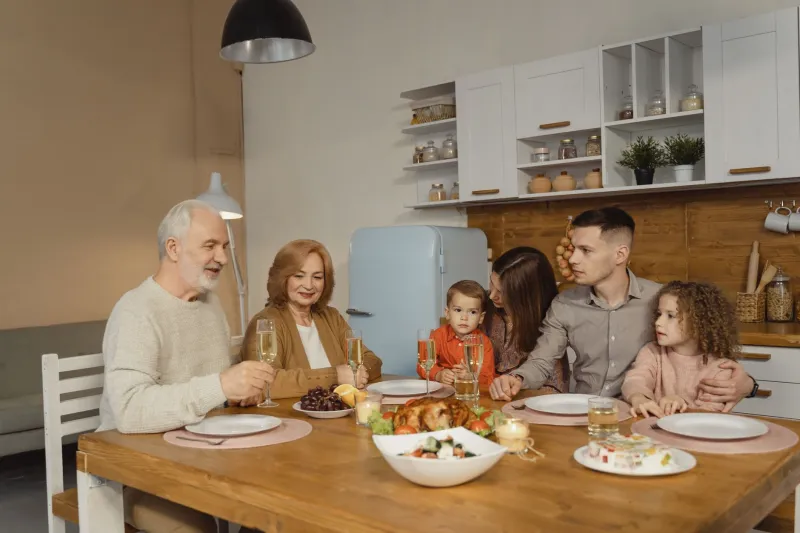
You've been planning this trip for months. Flights booked in September, time off approved, gifts carefully chosen and bubble-wrapped into your checked bag. You've genuinely missed your people. You've missed your mom's cooking and your dad's bad jokes and the particular way your childhood home smells in December.
And then you land. You clear customs, you hug everyone at arrivals, and somewhere in the car ride home — usually around the point when someone asks if you've "gotten used to the food over there" — it starts. That quiet, low-grade hum of effort. The one where you realize you're not just visiting. You're performing.
The Role They're Expecting You to Play
Here's the thing about going home for the holidays as an expat: your family and friends have a version of you that's been frozen in amber since the day you left. They've updated it slightly — they follow your Instagram, they've seen the photos, they know you went to that market in Lisbon or that night market in Chiang Mai — but the core file hasn't changed. To them, you're still largely the person who grew up in that house, sat at that table, and had that particular laugh at Thanksgiving.
They're not wrong to hold onto that version. It's the one they love. But it's also not quite you anymore, and the gap between who they expect and who you've become is where all the emotional labor lives.
Code-switching is a term most people associate with language or cultural identity, but expats do a version of it every single holiday season. You swap out the vocabulary you've picked up, the opinions you've formed, the habits that have quietly rewired your daily life. You recalibrate your humor, your references, your sense of what's normal. You do it automatically and mostly without resentment — because you love these people and you don't want every dinner to become a TED Talk about how living abroad changed your worldview.
But it's exhausting in a way that's hard to name, let alone explain.
Managing the Expectations Room by Room
Holiday gatherings have a particular architecture when you're the one who left. There's usually a curious aunt who wants the highlight reel — the beautiful sunsets, the charming cobblestone streets, the cafes. There's a skeptical uncle who wants to know when you're "coming back for real." There's a parent who's proud but quietly worried, and a sibling who's maybe a little envious, or maybe a little relieved they stayed, or both at once.
Each conversation requires a slightly different version of you. For the aunt, you pull out the stories. For the uncle, you deflect with humor. For the parent, you reassure. For the sibling, you read the room.
None of this is dishonest, exactly. But none of it is the full picture either. The full picture — the hard weeks, the bureaucratic nightmares, the loneliness that hits at 2 a.m. in a foreign city, the profound disorientation of building a life somewhere new — rarely makes it to the holiday table. Because who wants to be the person who makes Christmas dinner feel like a therapy session?
So you edit. You curate. You become the expat character in the family story rather than the complicated, evolving human you actually are.
Why You Can't Quite Explain It
One of the strangest parts of going home is realizing that your life abroad is genuinely difficult to translate. Not because you lack the words, but because the experience doesn't compress neatly into dinner conversation.
How do you explain what it feels like to navigate a foreign healthcare system alone? Or the specific pride of finally having a real conversation in a language that isn't yours? Or the way your relationship to America itself has shifted — how you see it more clearly now, the good and the complicated, from a few thousand miles of distance?
You can try. Most expats do try, at least at first. But there's a particular look people get — kind, well-meaning, slightly glazed — when the explanation goes longer than two minutes, and you learn to recognize it fast. It's not disinterest. It's just the limits of shared context. They haven't lived it, so the details don't land the way they would with someone who has.
This is where a lot of expats quietly retreat into the performance. It's easier. It keeps the peace. It lets dinner be dinner.
The Guilt That Shows Up Uninvited
What makes holiday homecomings genuinely hard isn't the small talk or the jet lag or even the identity whiplash. It's the guilt that tends to ride shotgun the whole trip.
Guilt that you left. Guilt that you're not there for the everyday stuff — the random Tuesday dinners, the minor family crises, the slow accumulation of ordinary time. Guilt that you've changed in ways that create distance even when you're sitting in the same room. And sometimes, quietly, guilt that you're relieved to go back.
That last one is the one nobody really says out loud. But a lot of expats feel it — that particular exhale on the return flight, when the performance ends and you can just be the version of yourself that's been living this life you chose. It doesn't mean you love your family less. It means you've built something real out there, and returning to it feels like returning to yourself.
Finding the Moments That Actually Matter
For all the tension, holiday homecomings aren't just performances. There are real moments that break through — a late-night conversation with your sibling after everyone else has gone to bed, a morning walk with your dad that doesn't require any explanation at all, the specific comfort of your mom's cooking that no restaurant anywhere in the world has ever replicated.
Those moments are the reason you book the flight every year, even knowing what you're signing up for.
The trick, if there is one, is to stop expecting the visit to resolve the gap between who you are now and who they remember. It probably won't, not fully, not in five days over the holidays. The gap is just part of the deal when you've chosen a life that most people in your orbit haven't. You can hold it with some grace instead of fighting it.
You can play the character when you need to, and let the real version show up when there's space for it. You can love your people and your life abroad at the same time, without either one canceling the other out.
The performance doesn't mean the love isn't real. It just means you've gotten very good at holding two worlds at once — which, honestly, is something most expats have been practicing since the day they left.